
The one-sentence summary
Meetings can be transformed by adding drama, mining for productive conflict, and defining multiple types that clearly distinguish between purpose, format and duration.
Can’t be bothered to read it? Listen to the 5-minute summary in two parts.
Want to buy the book? CLICK HERE
WHAT THE BOOK SAYS 
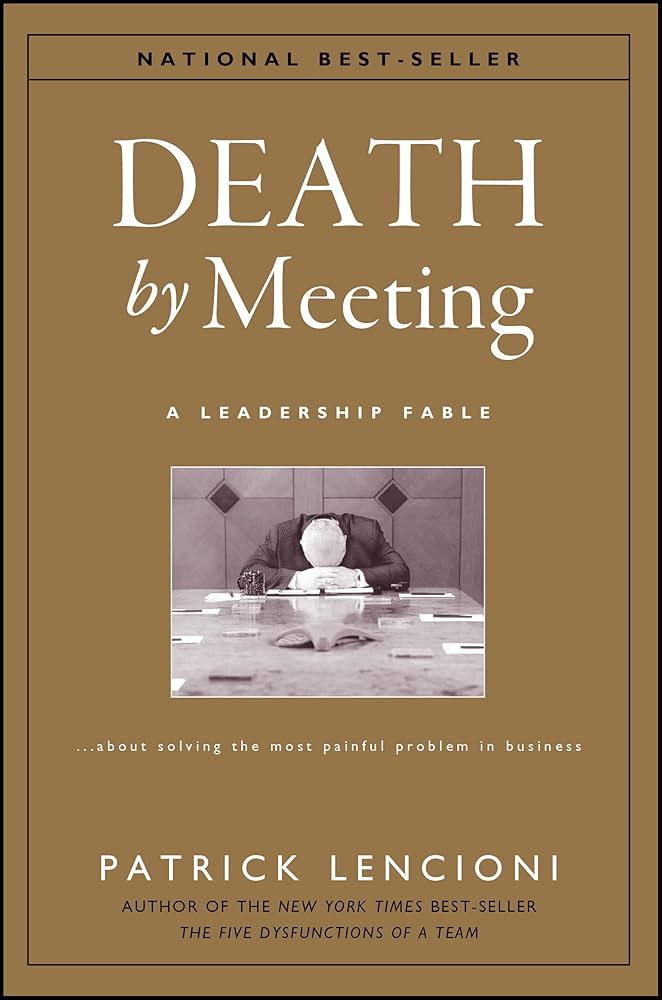
- As ever with this author, there is a fable that outlines a business issue – in this case, the curse of meetings. By example, it works through the biggest problems that occur when meetings are not planned and handled properly. In this particular case, the company has been acquired by another and the new owners feel that the meetings are so chaotic that it is affecting performance. As this becomes more extreme, there is even a suggestion that the CEO of the acquired company might lose his job as a result.
- Meetings are described as the most painful problem in business, which may well be true. They are certainly a paradox. On the one hand they are the activity at the centre of any organization. On the other, they are indeed frequently painful – frustratingly long and seemingly pointless.
- The good news is that there is nothing inherent about meetings that makes them bad, and so it is entirely possible to transform them into compelling, productive and sometimes even fun activities. The bad news is that in order to do this, it is necessary to fundamentally rethink much of the way we perceive and manage meetings.
- We need to stop focusing on agendas and minutes and rules, and accept that we should start with the attitudes and approaches of the people who lead and take part in them. There are two main problems with meetings:
- They are often boring, tedious, unengaging and dry.
- They are ineffective and often don’t contribute to success at all.
WHAT’S GOOD ABOUT IT
- Meetings are boring because they lack drama or conflict. Participants need to be mining for golden conflict. Constructive ideological conflict keeps people engaged and leads to more passionate discussions and better decisions.
- Meetings are ineffective because they lack contextual structure. Too many organizations have only one kind of regular meeting, involving a random discussion about everything from strategy to tactics to administrivia to culture. With no clarity around what topics are appropriate, there is no clear context for the discussions that then take place. Often very little is decided because the participants have a hard time working out whether they are supposed to be debating, voting, brainstorming, weighing in, or just listening. The author calls this meeting stew.
- To have more effective meetings, we need to have multiple types, clearly distinguishing between purposes, formats and duration. The key to injecting drama lies in setting up the plot from the outset. Attendees need to be jolted a little during the first 10 minutes so they appreciate what’s at stake. Mining for conflict follows and resolving the issues then becomes productive, engaging and sometimes even fun.
- The book recommends four types of meeting:
- The Daily Check-In: so long as it is practical in a company, depending on geography and time zones, this is best in person as a standing up huddle aimed at reducing confusion about how priorities are translating into action each day.
- The Weekly Tactical: includes the lightning round, in which everyone takes just one minute to explain one or two important issues, and a progress review. This meeting has a real time agenda based on disciplined spontaneity.
- The Monthly Strategic: in which executives wrestle with, analyze, debate and decide upon just a few critical issues. In some cases, an ad-hoc version of this meeting may need to be called.
- The Quarterly Off-Site Review: covers the large topics in a more holistic way -comprehensive reviews of strategy, teams, personnel, the competition and the industry or category.
- Suggested durations for these are 5 minutes for the daily check-in, 45 to 90 minutes for the weekly tactical, 2 to 4 hours for the monthly strategic, and 1 to 2 days for the quarterly off-site.
WHAT YOU HAVE TO WATCH
- Those who lead organizations and run meetings should realize that improving them is both an opportunity to enhance performance and a way to positively impact the lives of the people who have to attend them.