
The one sentence summary
Great, enduring organisations adopt a combination of 12 habits.
Can’t be bothered to read it? Listen to the 5-minute summary in two parts.
Want to buy the book? CLICK HERE
WHAT THE BOOK SAYS 
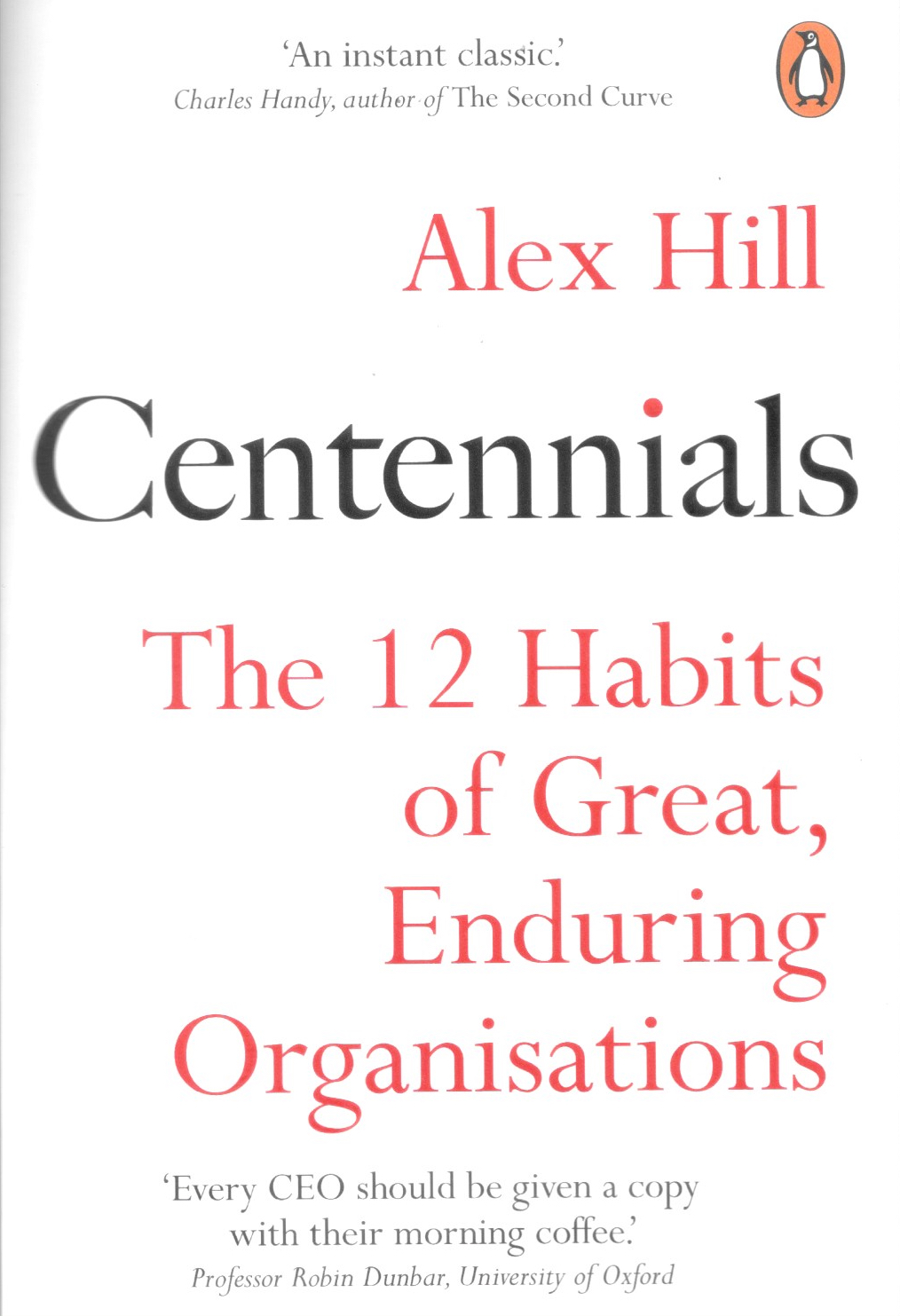
- The author has dedicated his career to studying high-performing companies and here he shares the secrets of those enterprises that have thrived for over a century. These are wide-ranging, including New Zealand’s All Blacks, Eton College, The Royal Academy of Music, British Cycling and NASA. The secret is to have a stable core combined with a disruptive edge.
- The stable core involves purpose (build your north star and do it for the kids’ kids), stewardship (have strong roots and mind the gap), and openness (perform in public and give more to get more).
- The disruptive edge involves experts (be porous and shake all trees), nervousness (get better, not bigger and X-ray everything), and accidents (make time for random and break bread).
- In summary, establish your core purpose and don’t deviate from it, always think long term, discuss mistakes and ideas in public, take the advice of experts beyond your field, be constantly on the lookout for new talent, allow for variation and spend quality time together.
- All of this adds up to being ‘radically traditional’ – adopting a stable nucleus of values developed over time and passed on by one long-serving generation to the next, whilst being constantly on the move, coming up with fresh discoveries and swapping ideas.
WHAT’S GOOD ABOUT IT
- A short-term approach makes sense to some organisations because they can see the benefit of hitting daily sales targets and achieving monthly budgets. This is based on the principle that if you don’t survive the short term, you won’t make it to the long term.
- However, if applied as a driving principle, the short term can actually destroy the long term by diverting attention from the important to the immediately visible. Sales get brought forward and investment gets cut – all in the name of hitting a particular target. Sadly, an obsession with the here and now, with short-term results, and with immediate shareholder value has come to dominate strategic thinking to the exclusion of almost everything else. If everyone is solely focused on the here and now, then long-term challenges are less likely to be addressed.
- Every year Harvard examines the performance of the 1,200 largest companies in the world. Contrary to the view that constant change is a good thing, 80% of the top CEOS every year were promoted from within the organisation and 80% have been in their current post for at least ten years.
- Any organisation that wants to stabilise its stewardship needs to address three questions: Who do we have that has the knowledge and influence to be a stable steward? How do we keep them? How do we bring on the stewards of tomorrow? The right people possess a deep understanding of what the organisation does, how it operates and what its fundamental beliefs and behaviours are. They won’t necessarily sit at the top – in fact, they probably occupy positions two to three levels down.
- Better and different thinking can often be stimulated by an adjacent stranger – someone who is far removed enough from the task that they can offer a fresh perspective, but not so far that they simply prove too disruptive. As the social researcher Harry Wolcott puts it: outsiders make the familiar strange, helping insiders find something new. Insiders make the strange familiar and execute it.
- Centennials often employ part-time people who have multiple interests and can have many projects ‘simmering on the back burner’ until adequate data, a new technique or a new insight finally comes to them. This approach has been described as slow-motion multitasking.
- When it comes to roles, management is best left to stable stewards, administration to effective executers, and new ideas and breakthroughs to the experts.
- Anthropologist Robin Dunbar reveals that 150 is the maximum number of contacts we can manage in our brains at any point in time. This is therefore the optimum largest size of a group. 300 is the maximum number of people to have in any one site before things start to get messy and lose momentum.
- In the positive deviant approach, someone from the outside provides the solution and those to whom it is directed may not believe it and have no investment in it. Their counterintuitive decisions going against the outside advice often provides better answers than the received wisdom.
- The OODA loop comes from the military: Observe (what’s happening), Orientate (by synthesizing all available information), Decide (if and how you want to move forward) and Act (quickly and decisively). It can be used in many aspects of business and sport.
- The Royal College of Art have a similar loop for designing: Discover (what’s already out there and what does and doesn’t work), Define (what might work better), Design (something new that ‘wows’ and could change people’s lives), and Deliver (that idea).
WHAT YOU HAVE TO WATCH
- Not much. There is much wisdom here and a helpful set of questions which can be applied to any organisation to see if it has what it takes to endure.