The one-sentence summary
Writers, musicians and artists thrive in an unpredictable world by embracing uncertainty – something that business leaders and politicians desperately need to do.
Can’t be bothered to read it? Listen to the 5-minute summary in two parts.
Want to buy the book? CLICK HERE
WHAT THE BOOK SAYS 
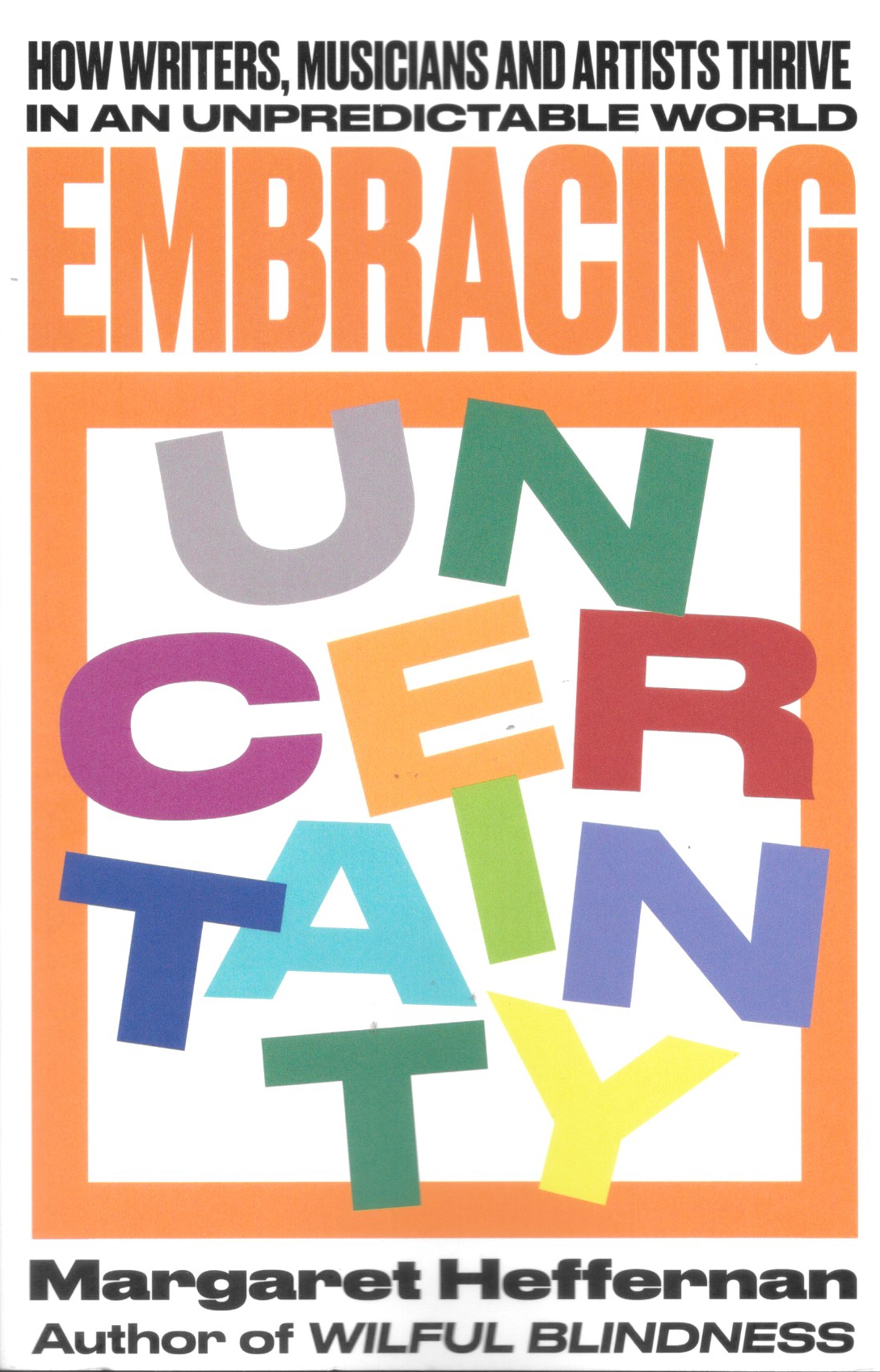
- Most people hate fear and uncertainty. It causes stress and anxiety so we often choose surrender over doubt, becoming passive, dependent, addicted and more anxious than ever. When we double down on the certainties promised by technology and micro-management, it only makes things worse, leaving little opportunity for innovation, adaptation or invention.
- Artists live with uncertainty constantly, but instead of waiting for the future they embrace it with agency and freedom. At a time when organisations of all kinds crave innovation but complain that their people lack creativity and initiative, the arts have never been so essential to our future. We may not all be artists, but we can learn to think like them. It takes stamina, freedom and endurance.
- However much we think about, monitor and analyse possible futures, we don’t really know what it holds. The unexpected will keep occurring.
- Management was designed to reduce risk, but dealing with uncertainty requires taking more of them: to start before all the information is in, to think beyond binaries, to imagine more deeply, to consider what’s never been thought of before. Meanwhile, the whole rigmarole of performance management isn’t working at all.
- Embracing uncertainty involves, among other things, having a mind that is open to different stimuli and that is constantly scanning the mental horizon for new things. Much of this can happen outdoors, but reading everything is another way.
- The author Margaret Attwood is a great fan of collecting newspaper clippings. At the beginning it is not clear what their connection is, but over time the brain identifies patterns, connections and themes – an intuitive form of sense making.
- As ideas develop, what can loosely be defined as thinking becomes what Hannah Arendt defined as having a conversation with oneself.
- Deep hanging out is what artists do when they’re wandering along streets, inside books, antennae alert. Stories become more interesting than facts.
- Boredom can lead to amazing productivity. Neuroscience shows that what might look like bunking off is, in a relaxed mind, a highly active state that allows for following mental clues. It takes an investment of time and attention with no guaranteed return. It feels risky because it is.
- Imagination is the opposite of efficiency. Efficient ways of working depend on repetition, but it is counterproductive when trying to create or discover something fresh, that has never been done before. Try to produce work too fast and what you get is generic, comforting and familiar, but ultimately disappointing because it’s nothing new.
- Uncertainty is resolved by patience and experimentation. Trying stuff.
WHAT’S GOOD ABOUT IT
- Patience. Courage. An eye for detail. Stamina. Minds open and alert to alternatives. The ability to live with paradox. A bringer-together of utterly disparate people, places and ideas: in an age of uncertainty, of polycrisis and systemic collapse, these are the qualities we need. Obedient, efficient, predictable, linear thinking won’t work – more of the same won’t get us out of the mess we are in. Which is why cutting back on the arts and downgrading them is astonishing.
- Observation, communication and noticing are fundamental to being able to galvanize groups of people to tackle threats and surprises – crucial leadership skills that the arts can inspire and provide.
- While the conventional image of the artist is often someone who is lazy, and somewhat infantilized because they are allowed to play around, the reality is exactly the opposite. Energy. Nerve. Decisiveness. Daring. Discipline. Stamina. When walking across ice, don’t stop.
- Ideas are just proposals: they can come from anyone. What matters is that only the best idea wins. It’s a radical, embodied form of writing and rewriting.
- “The search for knowledge is not nourished by certainty: it is nourished by a radical absence of certainty.” Physicist Carlo Rovelli
- “I like being alone. Call it idleness, procrastination, gestation: these are all underestimated. You have to tolerate nothing happening, but nothing happening is something happening.” Film maker Mike Leigh
- “Talent is insignificant. I know a lot of talented ruins. Beyond talent lie all the usual words: discipline, love, luck, but, most of all, endurance.” Writer James Baldwin
- “If you put a musician in a place where he has to do something different from what he does all the time, then he can do that – but he’s got to think differently in order to do it. He has to use his imagination, be more creative, be more innovative, he’s got to take more risks.” Miles Davis
- Income derived from all the arts in the UK in 2022 was £109 billion, more than twice the income of the pharmaceutical, aerospace and automotive industries combined.
WHAT YOU HAVE TO WATCH
- Perhaps unsurprisingly, the book contains numerous examples of writers, musicians and artists pursuing their work, not every one of which will be interesting to everyone, but the inspiration they provide is universally useful regardless of its source.